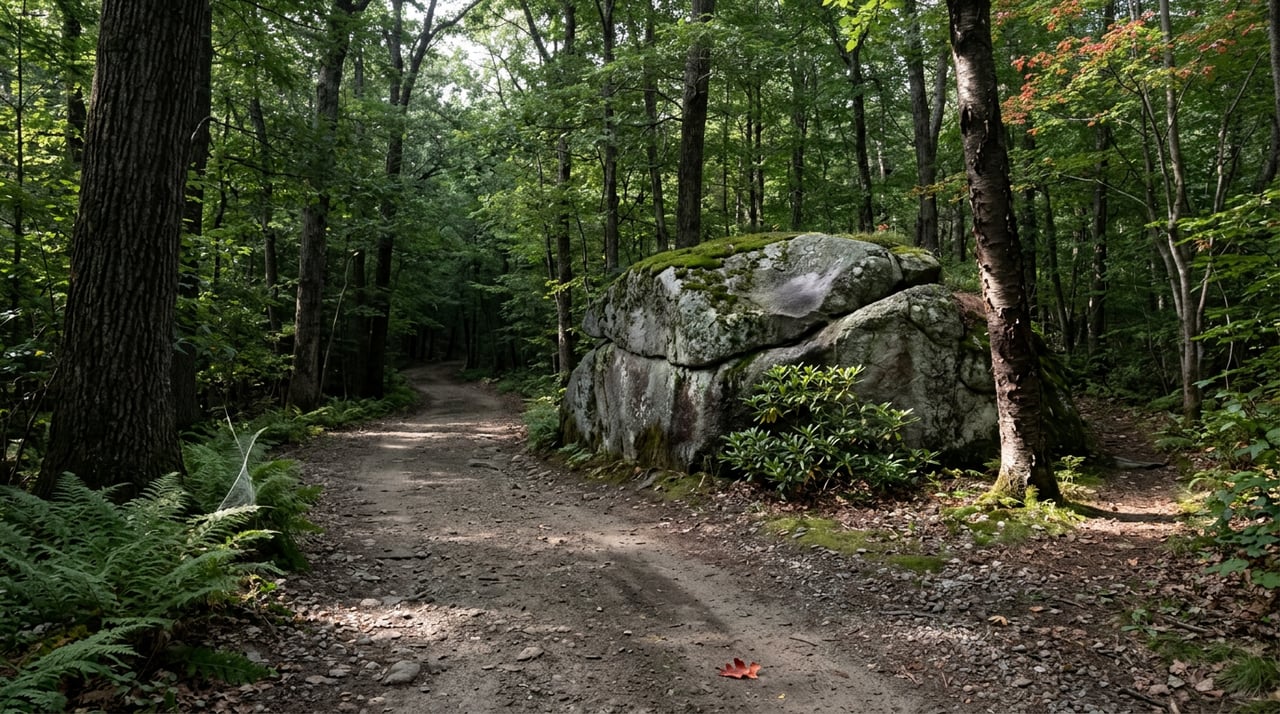
Ask three people who spend their weekends in Lynn Woods what kind of place it is, and you'll get three different answers. One will tell you about the Rose Garden and the walk out to Dungeon Rock. Another will describe a north-side descent that rattled every bolt in their bike. A third will mention the reservoir loop they run before work, when the woods are empty and the light comes in low through the canopy. All three are talking about the same 2,200 acres, founded back in 1881 as one of the largest municipal parks in the country. None of them are wrong.
That's the part of Lynn Woods that never quite makes it onto a trail map. It doesn't function like one park. It functions like three, stacked on top of each other depending on which entrance you walked in from and what you came looking for.
The Casual Side: Rose Garden, Amphitheater, Dungeon Rock
For most first-time visitors, Lynn Woods starts and ends near the main gates, where the Rose Garden, the Houghton Horticultural Garden, and the Amphitheater sit in the kind of manicured, shaded setting built for a Sunday walk rather than a workout.
Then there's Dungeon Rock, the park's best story. Legend holds that a pirate named Thomas Veal traded silver for tools from the Saugus Iron Works while hiding from authorities, buried a fortune in a cave here, and was trapped inside when an earthquake struck in 1658. More than a century later, a man named Hiram Marble became convinced spirits had told him where to dig. He moved his family to the site in the mid-1800s and spent decades tunneling through solid rock, searching for treasure he never found. The cave he carved is still there, sealed behind an iron door, open to visitors by appointment.
Nearby, Burrill Hill holds a 1930s WPA-era stone tower, built as a fire lookout on what remains the highest point in the city. This is the version of Lynn Woods most people picture when they hear the name. It's also the smallest slice of what's actually out there.
The Technical Side: Where Climbers and Mountain Bikers Go
Head north from the main loop and the character of the woods changes fast. Lynn Woods has quietly become one of the more serious bouldering destinations in New England, and it happened with almost no fanfare outside the climbing community. On Mountain Project, climbers describe the number and quality of problems here as rivaling Pawtuckaway and Lincoln Woods, two spots people happily drive well outside Boston to reach. The scene traces back to pioneers like the late Rich Baker and Bob Johnson, whose routes are still considered classics: Baker's Bulge, Endless Summer, Independence Day, Tomb Raider, Cavity Search. A later wave of developers, including Pete Otis and Andy Scott, kept expanding the terrain until the park was organized into 13 distinct climbing areas. Otis and Scott have gone as far as calling it the best bouldering within an hour of Boston.
Mountain bikers describe a similar split down the middle of the park. On riding forums, locals note that the north side holds the big technical features while the south side is less extreme but still genuinely challenging. One popular loop alone carries 311 feet of elevation gain, steep for a park sitting this close to the coast. The terrain is rocky and root-heavy enough that the Southeast New England Climbers Coalition now works directly with the city and the park ranger to keep the technical zones passable, without over-marking them. The local ethos has always leaned toward finding your own line rather than following arrows.
None of this is signposted at either gate. You find it by asking around, or by following the mountain bikers who show up on a weekday morning.
The Working Side: Three Reservoirs You Can't Swim In
The third version of Lynn Woods is easy to miss because it looks the most like a postcard. The park holds three active reservoirs, and they aren't there for scenery. They supply the City of Lynn's drinking water. That single fact drives most of the rules that surprise first-time visitors:
- No swimming, boating, or fishing in any reservoir, no matter how still the water looks on an August afternoon
- Dogs must stay leashed throughout the reservation, and owners are responsible for cleaning up after them on every trail, road, and parking lot
- Fires are banned outright unless you've secured a permit
- The reservation closes at night
None of it is arbitrary. It's a working water supply that happens to also be a park, and the two functions coexist because people follow the rules.
Picking Your Entrance, and Your Hour
Regulars don't just pick a side of the woods. They pick a gate and a time of day. The two main entrances sit off Walnut Street and off Lynnfield Street near Great Woods Road, with a smaller access point at Pennybrook Road that lands you closer to Dungeon Rock and the steel tower loop. Weekend afternoons in summer draw a crowd once the weather turns reliably warm. The people who know the park best tend to go early, before the lots fill, or wait for the quieter months when low light through bare branches makes the reservoir trails feel private again.
What's Actually on the Calendar Right Now
None of this is theoretical for the next few weeks. The Lynn Woods Relay returns on Wednesday, August 26, a longstanding team race with results tracked back to 1973, sending four-person teams through a 2.5-mile loop that starts at 6 p.m. from the Great Woods Road entrance. Registration closes August 18.
Further out, the Pink Angels Lynn Woods 5K Trail Run is set for October 21, a run and walk starting near Great Woods Road that has raised more than $2 million for breast cancer research and outreach since it began in 2005. It's the kind of event that turns an ordinary trail morning into something the whole neighborhood shows up for.
The Park You Get Depends on the One You're Looking For
None of these three versions of Lynn Woods cancel each other out. The same acreage that holds a fire tower and a rose garden also holds some of the more demanding bouldering and mountain biking terrain in the region, sitting directly on top of the reservoirs that keep the city's taps running. What changes is which entrance you walk in from, what hour you show up, and whether you came for a quiet loop or a technical descent.
That layering is part of what makes Lynn Woods worth paying attention to if you already live near it. It rewards repeat visits differently than most parks its size, because there's genuinely more than one park to discover once you've walked the obvious loop a few times.
If you're curious how a neighborhood like this fits into the bigger picture of North Shore living, or you're weighing what daily life looks like in Lynn versus a town like Swampscott or Peabody, Trohon Real Estate has spent more than 15 years learning these towns from the ground up. Let's start a conversation.